
„Auslandsdeutsche des Jahres 2025/26“ kommt aus Ungarn!
24. November 2025
In Berlin steht das größte Dinosaurier-Skelett der Welt
22. Januar 2026
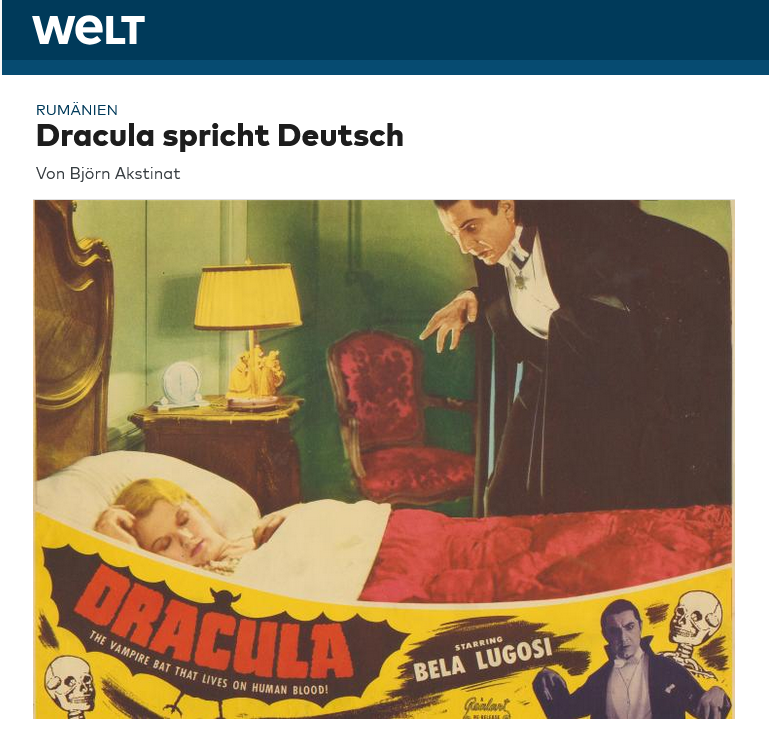
In April 2025, the German daily newspaper DIE WELT published an article that caused quite a stir in literary circles. Berlin-based media and language expert Björn Akstinat took in this article an in-depth look for the first time at the German elements of Bram Stoker’s horror novel „Dracula“.
Many literary scholars have already studied Stoker’s work, but they failed to recognize the significant role of these elements and, if they did, only mentioned them in passing. Akstinat is the first to explicitly point out that Stoker has Count Dracula speak German in his novel.
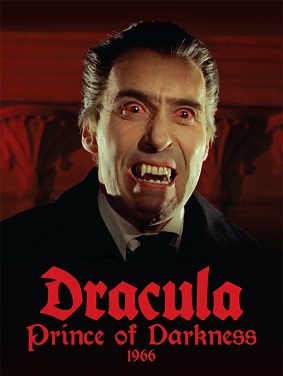 But that’s not all: The newspaper article demonstrates the significant role the German language plays in the world-famous work of the Irish-British author. This is primarily due to the vampire’s chosen residence. In his 1897 novel, Stoker has Count Dracula reside in a castle in German-speaking Transylvania. At that time, Transylvania was not part of Romania, but rather within the Austro-Hungarian Empire. The region’s most important cities today, such as Sibiu (Hermannstadt), Cluj-Napoca (Klausenburg), Mediaș (Mediasch), Brașov (Kronstadt), and Bistrița (Bistritz), were all founded by Germans.
At the beginning of the novel, the London lawyer Jonathan Harker travels via Munich to Transylvania to meet Count Dracula. For the Transylvanian towns near Dracula’s castle mentioned in the original English text, Bram Stoker exclusively chose the German names such as Bistritz or Klausenburg instead of the Romanian names Bistriţa and Cluj-Napoca, which were already in common use at the time.
In addition to choosing German city names, Stoker also has Jonathan Harker stay in a hotel with a German name and staff: „It was on the dark side of twilight when we got to Bistritz, which is a very interesting old place. … Count Dracula had directed me to go to the Golden Krone Hotel … I was evidently expected, for when I got near the door I faced a cheery-looking elderly woman … When I came close she bowed and said, ‚The Herr Englishman?‘ – ‚Yes,‘ I said, ‚Jonathan Harker.‘ “
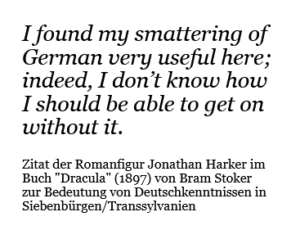 The character Harker says in one of the first paragraphs of the book: „I found my smattering of German very useful here; indeed, I don’t know how I should be able to get on without it.“
He is able to converse with all the locals in Transylvania in German as the story progresses.
Count Dracula’s coachman, who picks up Jonathan Harker at the Borgo Pass in the Carpathian Mountains east of Bistritz, also speaks perfect German: „The driver said in excellent German: ‚The night is chill, mein Herr, and my master the Count bade me take all care of you.‘ “
Akstinat points out for the first time that the coachman is revealed later in the novel to be Count Dracula himself. This means that the vampire of all vampires has an excellent command of Goethe’s language. No other literary study is known to have so clearly highlighted these sensational details.
Bram Stoker knew Germany through his travels and revered the musical genius Richard Wagner. His love for German culture is probably the reason why he has several characters speak German, quotes a German poem in its original form, and initially intended to set the entire beginning of the novel in Bavaria and Austria.
Thanks to Björn Akstinat, who has already published several specialist books on the international relevance of the German language, we now know about the numerous German elements in this piece of world literature.
This article by Susann Niros was published in German in the „Siebenbürgische Zeitung“ (Transylvanian Newspaper) at the turn of the year 2025/26: www.siebenbuerger.de
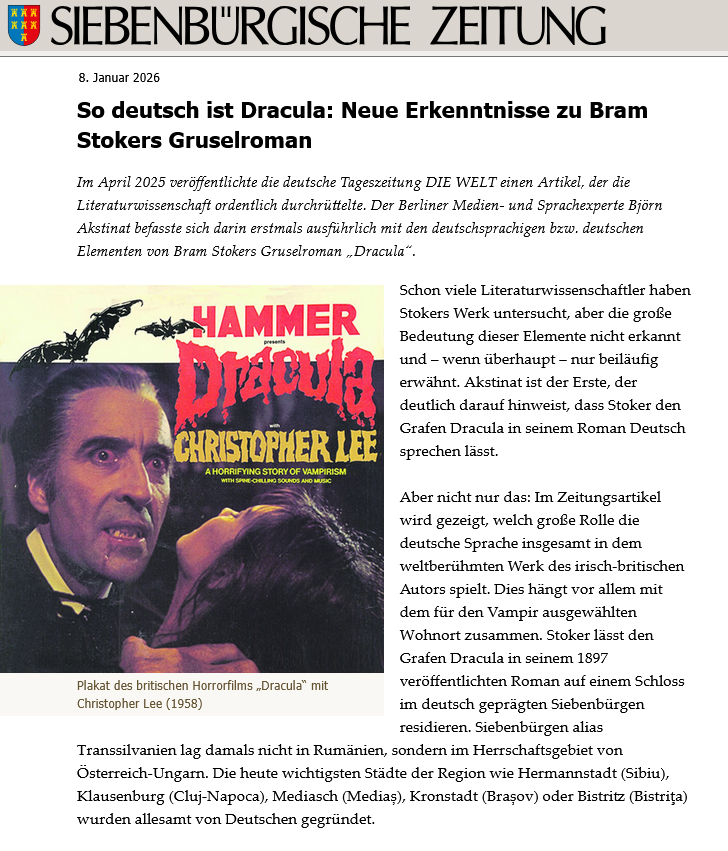
The original article by Björn Akstinat from the German daily newspaper DIE WELT (published in April 2025): www.welt.de